
Monday, May 4, 2009
www.benjaminandbekah.blogspotcom

Friday, March 20, 2009
breathing oxygen into the mortar of society
In John 1 there is this absolutely beautiful description of the incarnation of Christ. John, with the utmost of eloquence, carefully outlines everything that Christ is in an indisputable way.
“ 1:1 In the beginning was the Word, and the Word was with God, and the Word was God. 2 He was in the beginning with God. 3 All things were made through him, and without him was not any thing made that was made. 4 In him was life, [1] and the life was the light of men. 5 The light shines in the darkness, and the darkness has not overcome it.
6 There was a man sent from God, whose name was John. 7 He came as a witness, to bear witness about the light, that all might believe through him. 8 He was not the light, but came to bear witness about the light.
9 The true light, which enlightens everyone, was coming into the world. 10 He was in the world, and the world was made through him, yet the world did not know him. 11 He came to his own, [2] and his own people [3] did not receive him. 12 But to all who did receive him, who believed in his name, he gave the right to become children of God, 13 who were born, not of blood nor of the will of the flesh nor of the will of man, but of God.
14 And the Word became flesh and dwelt among us, and we have seen his glory, glory as of the only Son from the Father, full of grace and truth.
How beautiful is that? In Eugene Peterson’s “the message” he translates verse 14 saying “the word became flesh and blood and moved into the neighborhood.” This Jesus who is fully God and has been since the beginning, steps down off of his thrown above, becomes flesh, and moves into the neighborhood. Jesus chose to lay roots in the bricks of this messy world and breathed his breath of life into mortar of our society.
Jesus Christ’s life, death, and resurrection sets the tone for our ministry as Christ followers. Christ came became fully human, and yet remained fully God. Christ then left this world with a charge to his followers to continue his ministry. He gave us a perfect example of incarnational ministry and instructs us to follow.
Lately I’ve been walking the streets of my neighborhood a lot. Living in North Minneapolis has taught me so much about life. The real kind of life with pain, addictions, and trials. This analogy that I’ve been drawing leaps to life when walking these streets.
It comes to life because amidst all this pain, addiction and difficulty, I see the breath of a living God. I see this breath embodied by my neighbors who are making a way through some of this mess and reaching for a way out. I see it through the countless individuals who have given up the temptation and comfort of suburban living to sink roots here in the city and be a good neighbor. I see it through the numerous youth programs that seem to be popping up everywhere offering hope for children and a way out of this vicious cycle of poverty. This is the kind of breath that Jesus was about, this breath of hope over disparity, relationship over corporation, life over death. This kind of breath is irresistible, it calls to me, it makes me question what kind of breath I am breathing - makes me want to take root. It compels me to want to get outside of myself, sink root into the mortar of this society and breath the very breath of life that Christ mandated that we breath into our world.
Monday, February 16, 2009
Our House
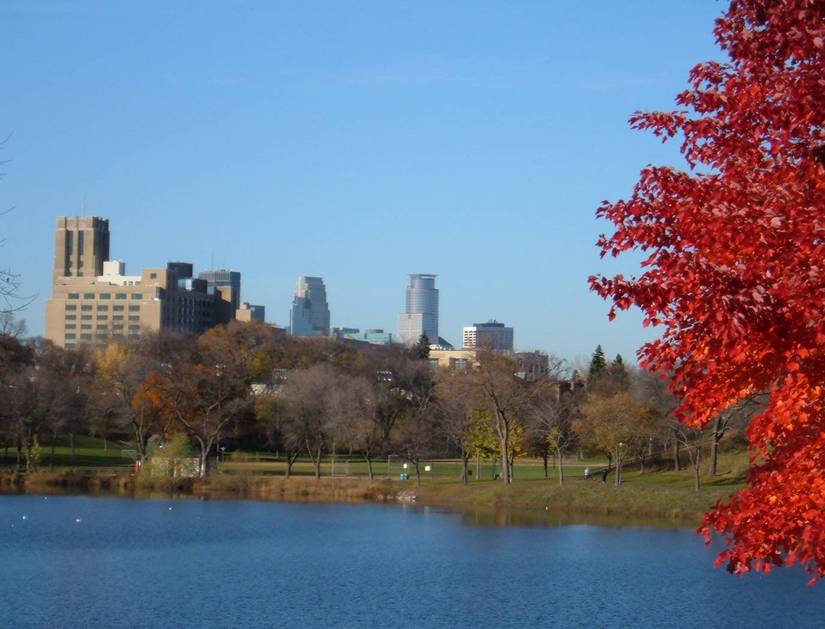
The Powderhorn neighborhood is an inner city, south Minneapolis community, centered around a large park which sits in the middle of the neighborhood. Powderhorn is a vibrant community known for its diversity and although it has historically been viewed as a "rough neighborhood", in the "margins of Minneapolis" there is a spirit of entrepreneurship that permeates through the community and is embodied by the plethora of successful Hispanic and African store fronts along lake street.
view from the park

Thursday, February 12, 2009
My trip to Pennsylvania
Tuesday, October 28, 2008
she said yes.


Wednesday, October 15, 2008
The lake superior hiking trail


Monday, September 17, 2007
From dead works to a living God.
There is somewhat of a legend at Malone of a professor who recently retired. This German professor who had fought on the German side during WWII had a habit of standing in front of a class, his withered body leaning against a podium for support and exclaiming, “You must remember the Christ event!” He emphasized this point in every lecture he ever gave. He clung to the fact the Christ event was a necessity for every sermon, lecture, and piece of writing and he is probably right.
It was several years ago now that I began to contemplate and roll around the impact of this historic event. I was writing a research paper on several different theories that exist today regarding the death and resurrection of Christ and It was at this time that i really began to grasp the implications of the Christ event, it changed everything. I can say now that this time period for me gave me a very elementary understanding, but none-the-less this understanding was something new to me. I realized at this time how dramatic this event was, it changed the way the world oppreated. If it were not for the Christ’s, life, death, and resurrection we, as gentiles, would be as lost as lost can be, stumbling around in a world with absolutely no hope.
My story continues in an interesting way. During my under grad education I was required to do a very lengthy and in depth study of world religions. During this course we chose a few specific religions we wanted to really delve into and write up a research paper on. About mid way through the semester I chose to research Judaism, for me as a Christian, it made sense to do this. I became fascinated with the Jewish laws and customs rooted in the Torah, I read everything I could get my hands on and purchased a book of key portions of the Talmud. I attended a few Jewish services including a Mesionic service several times and looked into the Hebrew language. On a surface level, I even attempted eating Koshor for a time although i gave this up when I realized that I couldent actually eat out at any resturants, would not be able to eat at our school cafeteria, could not eat at my parents house, and would have to buy all new kitchen equipment if I ever really wanted to experience true, torah mandated, koshor eating. Suffice it to say, I was very intrigued by the Jewish law, the law of the old testament, I found beauty in ritualistic practices. I began to wonder, where is this kind of beauty in Christianity?
This attitude is what led me to really develop my thoughts about the Christ event. The history of Christianity began in a small room after the ascension of Christ by a group of people committed to living out this revolutionary kingdom that Jesus Christ had introduced. I wish that I could have been a fly on the wall sometimes as these first Christians processed the implications of this new law. Can you imagine growing up in Jewish culture and being told that there was no longer such a thing as “unclean”? That this gospel was a global one? That we are now justified by faith alone and not by works like circumcision, sacrifices or eating habits? These are practice that we never would dream of as 21 century christians (unless your a weirdo religion nerd like me and try the actually near impossible practice of eating kosher, or like my friend who kills a bull everytime he lies  jk). So what happened? Were these jewish people being asked to simply give up their ideas of creating sacred places, and following the jewish law? Hardly.
In Mathew 5.17 Christ is in the process of giving the first of his five major discourses, what we know of today as the sermon on the mount. He was addressing all kinds of hot button issues and probably raising all kinds of eye brows. During this time he shoots out a little disclaimer, stating ” Do not think that i have come to abolish the law or the prphets; I have come not to abolish but to fulfill. For truly I tell you, until heaven and earth pass away, not one letter, not one stroke of a letter, will pass from the law until is is accomplished.” Interesting. What do we as Christians living in the light of the New testament do with this kind of a statement? I have no doubt that this is the kind of statment that the early Christians battled with as well, as evidenced by the many letters written thorughout the N.T. outlining that we are no longer under the law, but how is that?
We find the answer to these questions in Hebrews. The book of Hebrews is known by most scholars as an anonymous sermon directed towards a Christian community comprised probably mostly of Jews who without a doubt are struggling with what to do with the Jewish law outlined in the Septuagint. In Hebrews chapter nine the author begins to in advanced understanding describe the “first covenant” referring to the Torah. The passage specifically refers to the reitualistic practice of cleansing by a high priest, and the entering into of the holo of holies which was restricted to the high preist. Hebrews 9.11-14 puts all of this in the light of the new covenant, “But when Christ came as a high priest of the good things that have come, then through the greater and perfect tent (not made with hands, that is, not of this creation) he entered once for all into the Holy Place, not with the blood of goats and calves, but with his own blood, thus obtaining eternal redemption. for if the blood of goats and bulls, with the sprinkling of ashes of a heifer, sanctifies those who have been defiled so their flesh is purified, how much more will the blood of Christ, who through eternal Spirit offered himself without blemish to God, purify our conscience from dead works to worship the living God!” The author goes on. “For this reason he is the mediator of a new covenant, so that those who are called may receive the promised eternal inheritance, because a death has occurred that redeems them from the transgressions under the first covenant.” LAW: ACCOMPLISHED. Completed, fulfilled, payed for, we now move from dead works to a living God! How exciting is that? Because of the blood that Christ shed on the cross we live under a new convenant in which we carry the sacredness of God in our flesh. Everyplace is sacred, every food is blessed, every sin forgiven. We walk under this light. To understand this convenant is to understand that there is absolutley nothing we could ever do to deserve it. It is unmerited, we cannot earn it, there is nothing we could ever due to earn a slavation like this.
As Augustine puts it, “Humanity is justified as an act of grace. Even human good works are a result of God working within fallen human nature. Everything leading up to salvation is the free and unmreited gift of God given out of love for sinners. Through the death and resurrection of Jesus Christ. God enabled to deal with fallen humanity in this remarkable and generous mannor, giving us what we no not deserve, (salvation) and withholding from us that which we do deserve (damnation).
How beautiful is that? Beautiful enough to give your life for the kingdom? It is through this salvation that we grow towards Christ and receive that gradual gift of sanctification in which we begin to long for the very things that Christ longs for.
I am not discounting the Old Testament as irrelevant, on the contrary, it is through the understanding of the first covenant that we fully understand the new covenant. This is a grad drama, and every part matters. I also still find beauty in the Jewish customs, for those who are interested in these I suggest reading Lauren Winners “mud-house Shabot” A wonderful book written by a formally orthadox Jew from a now christian perspective, she knows what shes talking about. And although my “going kosher” was probably more offensive to jews by thinking I was eating Kosher from the same pan that bacon was cooked in a week ago, then anything else, there is still alot to learn from the Jewish law. However, as my German prof would say, WE MUST REMEMBER THE CHRIST EVENT!”
May you live daily in the undeserved grace given to you, and continue to grow in Christ and desire what he desires.
